
Blog
2026-05-02
The men's World Cup is coming up, so it's time to work out the cost of filling the official Panini sticker book again.
Panini are boasting that this year's sticker book contains more stickers than ever, which can only mean one thing: you're going to have to buy more stickers than ever.
But how much more than last time is completing this sticker book going to cost you?
Buying stickers
This year, you can buy:
- A starter pack that includes a sticker book with 6 stickers (that are always the same and hence guaranteed to contain no duplicates) and 4 packs of 7 random stickers. This costs £4.99.
- Packs of 7 random stickers. Various sources claim these are £1.25 each, although our local Morrison's is selling them for £2.
- Multipacks of 6 or 8 packs of 7 random stickers. Both these multipacks work out at £1.25 per pack.
- Multipacks of stickers that come with a nice metal box to keep your swaps in (you'll need a few of these if you're planning to complete your collection). These are releasing later than the rest of the collection, but look like they'll work out at £1.25 per pack plus £1 for the metal box.
For the rest of this blog post, we'll assume that all
stickers are bought in multipacks.
)
)
Every album includes Declan Rice (England), Heechan Hwang (South Korea), Alexis Vega (Mexico), Mikel Merino (Spain), Danley Jean Jacques (Haiti) and Nicolas Jackon (Sengal)
How many stickers will I need?
After you've stuck your first 6 stickers in, you need to collect 974 more stickers.
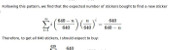
Following the same method as I did in 2018, we can work out that if you want to get all of these from packs of random stickers, then
you should expect to buy 7265 stickers (including the 4 packs in your starter pack). Including the cost of the starter pack, buying all these stickers will cost
£1297.35.
But as always, you don't have to spend this much, as Panini let you order the last \(n\) stickers (for any value of \(n\) that you choose, although I have strong memories
of \(n\) being 50 when we had to send off paper sticker ordering forms when I was at school). On the Panini website, they're selling missing stickers
for 45p per sticker*.
If you decide to order the last 50 stickers, then you should expect to buy 2883 stickers to get the rest of the stickers before ordering the last 50. In total this will
cost you £532.81. That's a big saving.
What is the best number of stickers to order?
If you want to minimise the amount that you have to spend to complete this sticker book, you should choose your value of \(n\) wisely. This plot shows the expected total cost
of completing the sticker book if you decide on different numbers of stickers to order:
)
The lowest expected cost is achieved when ordering 386 stickers: £334.54. That's an even bigger saving, although 386 does feel to me like an unreasonably large value for \(n\).
Swapping
As always, the cheapest way to complete the sticker book is to convince more of your friends to collect too so that you can swap your duplicate stickers with them. You could get
the price down as low as £174.99 if you manage to swap every single duplicate that you get.
If you decide to set \(n\) to 0, there's a good chance that going out now and buying 200 starter packs for £998 to give to your friends make them start collecting will mean spending less money in total
than trying to complete your sticker book on your own...
Edit: The first version of this blog post guessed that the missing stickers would cost 36p each, as this was the cost for other recent collections. The numbers have been updated to match
the 45p that Panini are actually charging. The original lowest cost based on 36p was ordering 483 stickers to give a total cost of £295.78.
 ×3 ×2 ×2
 (Click on one of these icons to react to this blog post)
You might also enjoy...



Comments
Comments in green were written by me. Comments in blue were not written by me.
Add a Comment
2026-04-20
This is an article that I wrote for
Chalkdust issue 23, and the
new puzzle it introduces appears on the cover of issue 23.
In January, I paid a visit to MathsWorld, the recently opened maths discovery centre
in London, alongside some other members of the Chalkdust team.
One of the highlights of the trip was playing the two-player game Genius Square.
In Genius Square, you start with a six-by-six board and roll seven dice. These dice tell you where
to place seven cylindrical blocks, for example:
)
The dice
)
)
The board with the cylinders placed and the pieces
The two players then race to fit the pieces shown above into the remaining space on the
board. The pieces that the players have are
the five tetrominoes,
the two triominoes,
a domino,
and a single square (or monomino); these are all the shapes you can
make by gluing together up to four squares (if rotations and reflections are considered the same
shape).
If you want to ruin/improve your copy of Chalkdust, you could cut out the pieces shown above and
try to fit them in the board to the left.
There's some clever design in this game:
if, instead of rolling the dice, you were to randomly pick any set of seven spaces to place the cylinders,
the puzzle is not guaranteed to have a solution.
The locations printed on the dice have been carefully chosen so that any combination that you can roll
leads to a solvable puzzle.
A puzzle-a-day
The Genius Square puzzle is similar to another rearrangement puzzle: the puzzle-a-day calendar,
created by the Norwegian puzzle makers DragonFjord.
)
)
The puzzle-a-day board and pieces
In this puzzle, you are given the pieces below
and asked to place them on the board to cover everything except
today's date. For example, on 22 July, you could place the pieces like this:
)
A solution of puzzle-a-day for 22 July
DragonFjord make and sell wooden and plastic versions of puzzle-a-day, which
you can buy from Maths Gear—who
also provide the top prize for the crossnumber—to
avoid the cost of shipping directly from Norway.
In puzzle-a-day, it's possible to arrange the pieces to make every single combination
of a number and a month, including days that don't exist like 31 September and 30 February.
)
A solution of puzzle-a-day for 31 September?!
While we were considering options for the cover of this issue, we discussed putting something
like Genius Square on the cover, and I began to wonder
if it would be possible to make
a puzzle like puzzle-a-day but where it was only possible to make days that actually appear on the
calendar.
A new puzzle
After spending a while scribbling on squared paper and getting nowhere,
I had an idea: I could put the months in regions that were disconnected from the day numbers. Then,
by carefully choosing the shape of the month regions and the arrangement of the dates, I could force
the solver to use different combinations of pieces on the day numbers for different months.
Once I'd had this idea, I threw together some Python code that could see which day numbers
you could and couldn't leave uncovered with a set of pieces, and waited for it to find a good
set of pieces. It found this board and these pieces:
)
)
The board and pieces for the new puzzle
As in Tetris, I've named the pieces after letters that they vaguely resemble.
In January, March, May, July, August, October and December, you have to use
a P, an O and the A in the month regions.
The remaining pieces can make any day from 1 to 31.
In April, June, September and November, you need to use the C, an O and the A in the month regions.
This leaves pieces that can make any day from 1 to 30, but importantly can't make 31.
In February, you need to use both Os and the C in the month regions.
This leaves pieces that can make any day from 1 to 29, but not 30 or 31.
Now all we need to do is find another new arrangement that somehow works differently in leap and non-leap years...
×1 ×1 (Click on one of these icons to react to this blog post)
You might also enjoy...


Comments
Comments in green were written by me. Comments in blue were not written by me.
Add a Comment
2026-04-06
I've recently been thinking about Wordle,
the Mastermind-style
word guessing game, that everyone was playing and talking about in 2020. Specifically, I've been
thinking about mixing Wordle with other games.
Tetris
The first game I tried mixing Wordle with is Tetris, the addictive puzzle game that made
tetrominos famous.
In Wordle, letters that you guess are coloured green (letter in the right place),
yellow (letter that's in the answer but in the wrong place), or grey (letter not in the answer).
Inspired by noticing that the yellow squares in one of my Wordle attempts made a Tetris S-block, I
created a new bot on Bluesky: @wordle-tetris.bsky.social.
This bot posts a set of six words each day that make the next frame in a game of Tetris when
used on Wordle. Every time, the bot is given a new piece, it quickly rotates and moves it into
what it thinks is the best position (24 hours
between frames gives the bot a lot of time to press the buttons to do this) then lets the block fall.
Currently, the bot does not move or rotate the block as it falls.
For example, the bot's first post was:
| L | U | R | I | D |
| P | U | L | U | T |
| A | A | R | G | H |
| R | H | O | N | E |
| B | R | I | D | E |
| R | E | F | A | N |
The following day it posted:
| W | E | B | B | Y |
| T | R | A | I | N |
| A | T | R | I | A |
| L | E | V | E | L |
| L | I | M | M | A |
| W | I | P | E | D |
It continued until it posted this on the fifth day:
| B | U | N | D | U |
| K | A | P | P | A |
| M | A | C | C | A |
| D | U | R | A | L |
| H | O | K | U | M |
| M | O | I | L | E |
| C | O | R | K | Y |
| L | E | F | T | E |
| D | O | R | S | A |
| F | E | D | E | X |
| S | T | R | O | P |
| E | T | A | P | E |
On the eighth day,
the bot reached its first game over, as there was no valid word that could give this row:
After a couple of games, I updated the code that runs the bot so that it now picks
commonly used words whenever it can. This makes
the bot's more recent posts
look a lot more like actual guesses someone could have made:
| B | R | E | A | D |
| M | E | T | E | R |
| K | A | R | M | A |
| L | I | K | E | D |
| A | P | A | R | T |
| T | O | U | G | H |
In Wordle, it's impossible to get four green squares and one yellow square in a row, as if four
letters are correct, the other letter cannot be a correct letter in the wrong position. This means
that Wordle Tetris bot can never clear more than two lines at once, as a line with four greens and
a yellow must appear at some point on the way to the clearance. the bot can clear two lines at once
though if it mangages to set up something like this:
If you prefer your explanations in video form, Ayliean made a fun
YouTube short about the Wordle Tetris bot.
And if you're interested, the code that runs the bot is available on Codeberg.
Pokémon Blue
)
A Game Boy with Pokémon Wordle inputs
The other game that I've recently mixed Wordle with is Pokémon Blue.
Whenever I play Pokémon on an emulator, I use
W, A, S and D for the arrow keys,
K and J for the A and B buttons,
and O and I for the start and select buttons. In February, I started playing a game with the
keyboard input used to play both Pokémon Blue and Wordle.
To give myself a chance of
getting some way through the game, I'm allowed to know the solution to the day's Wordle and can
use it to play which words to use to get as many useful key presses as I can. Each day's video
is posted a day late to avoid spoiling Wordle for anyone still playing it.
Just over a week after starting, I'd pressed J and K enough to get
through the introduction and started walking around. After another ten days,
I picked Bulbasaur to be my starter pokémon then
promptly started a ten day long battle against my rival.
Probably the best day so far was day 46, when I
managed to find words to attack and knock out a pidgey, get thorough the post-battle text, then
walk four steps.
The full game so far is on this YouTube playlist.
So far, I've been playing for 53 days and have got about a third of the way along Route 1.
The current Pokémon Blue
speedrun record did this in 2 minutes and 51 seconds and went on to complete the game in 1 hour and 43 minutes.
Using this as a rough estimate of the proportion of the game completed, it looks like it'll take
around 5 and a quarter years to complete Pokémon Wordle. See you on Victory Road in May
2031...
×2 (Click on one of these icons to react to this blog post)
You might also enjoy...


Comments
Comments in green were written by me. Comments in blue were not written by me.
Add a Comment
2026-02-08
Welcome to 2026 everyone! It's time to reveal the answers to the Advent Calendar puzzles and announce the winners.
But first, some good news: with your help, Santa was able to order a new sleigh and Christmas was saved!
Now that the competition is over, the questions and all the answers can be found at mscroggs.co.uk/puzzles/advent2025.
Before announcing the winners, I'm going to go through some of my favourite puzzles from the calendar and a couple of other interesting bits and pieces.
Highlights
My first highlight is the puzzle from 9 December. I like this puzzle, and enjoy how it looks
like a complicated counting puzzle at first, but there's a much simpler method available...
9 December
In a 3 by 5 grid of squares, if a line is drawn from the bottom left corner to the top right corner, it will pass through 7 squares:
)
In a 251 by 272 grid of squares, how many squares will a line drawn from the bottom left corner to the top right corner pass through?
My next highlight is the puzzle on 17 December. This is a highlight because I just really like the puzzle.
17 December
A sequence of zeros and ones can be reduced by writing a 0 or 1 under each pair of numbers: 1 is written if the numbers are the same, 0 is written if they are not.
This process can be repeated until there is a single number. For example, if we start with the sequence 1, 1, 1, 0, 1 (of length 5), we get:
1
1
1
0
1
1
1
0
0
1
0
1
0
0
1
The final digit is a 1.
How many sequences of zeros and ones of length 10 are there that when reduced lead to the final digit being a 1?
My final highlight is the puzzle from 18 December, as I always enjoy a surprise Fibonacci.
18 December
There are 5 different ways to make a set of numbers between 1 and 5 such that the smallest number in the set is equal to the number of numbers in the set. These 5 sets are: {1}, {2, 3}, {2, 4}, {2, 5} and {3, 4, 5}.
How many ways are there to make a set of numbers between 1 and 14 such that the smallest number in the set is equal to the number of numbers in the set?
Hardest and easiest puzzles
Once you've entered 24 answers, the calendar checks these and tells you how many are correct. I logged the answers that were sent
for checking and have looked at these to see which puzzles were the most and least commonly incorrect. The bar chart below shows the total number
of incorrect attempts at each question.
| 1 | 2 | 3 | 4 | 5 | 6 | 7 | 8 | 9 | 10 | 11 | 12 | 13 | 14 | 15 | 16 | 17 | 18 | 19 | 20 | 21 | 22 | 23 | 24 |
| Day | |||||||||||||||||||||||
It looks like the hardest puzzles were on
21,
15 and
14 December;
and the easiest puzzles were on
3,
10,
5 and
8 December.
Ordering the sleigh
To finish the Advent calendar, you were tasked with ordering the correct parts for a new sleigh. The answers to all the puzzles were required to
be certain of which combination of parts was needed, but it was possible to reduce the number of options
This graph shows how many people successfully ordered a sleigh on each day:
| 21 | 22 | 23 | 24 | 25 | 26 | 27 | 28 | 29 | 30 | 31 |
| Day | ||||||||||
The winners
And finally (and maybe most importantly), on to the winners: 242 people managed to order a slieigh. That's a record high number!
| 2015 | 2016 | 2017 | 2018 | 2019 | 2020 | 2021 | 2022 | 2023 | 2024 | 2025 |
| Year | ||||||||||
From the correct answers, the following 10 winners were selected:
- Adrienne Hestenes
- Blake Segler
- Johannes C. Huber
- Matthew Harding
- Mr J Winfield
- Pamela Docherty
- Pete Chare
- Steve Blay
- Tim Dufton
- Vinny R
Congratulations! Your prizes will be on their way shortly.
The prizes this year include 2025 Advent calendar T-shirts. If you didn't win one, but would like one of these, I've made them available to buy at merch.mscroggs.co.uk alongside the T-shirts from previous years.
Additionally, well done to
100118220919SantaSixSeven9, A Hall, Aaron Kunze, Aisha Arroyo, Alan Buck, Alan Shotkin, alek2ander, Alex Bolton, Alex Slaughter, Allan Taylor, Anastasia P, Anastasiia, Andrea Chlebikova, Andrew Brady, Andrew Fermor, Andrew Roy, Andrew T, Andrew Thomson, Andy Ennaco, Artie Smith, Ashley Jarvis, B Witt, Becky Russell, beeplusdub, Ben Baker, Ben Boxall, Ben J, Ben Reiniger, Ben Semanko, Ben Tozer, Ben Weiss, Bill, Bill Russ, Bob B, Brian Wellington, Carmen, Cathy Hooper, Chad Smith, Chloe, Chris Dettmar, Chris Eagle, Chris Hazell, Chris Hellings, Christopher Adams, Clint Cabrera, Colin Beveridge , Colin Brockley, Connie, Cool Beans, Corbin Groothuis, Cristian Sbârciog, dajedrek, Dan Colestock, Dan May, Dan Whitman, Daniel, Daniel Low, Danny, Dave, Dave Budd, David, David Ault, David Berardo, David Carey, David Fox, David Kendel, Deborah Tayler, Dhruv Pisharody, Donagh, Donald Anderson, Dylan, Dylan Madisetti, Echo231, Elijah Kuhn, Elizabeth Madisetti, Ellie Winters, Elytre, Emily Troyer, Eoin Davey, epsilon, Eric Kolbusz, Erick Lee, Evan and Dana, Evan Denney, Evan S, Ewan Beetham, F Z, Fabien Friedli, Fionn Woodcock, Frank Kasell, Fred Verheul, Gabriella , Gareth McCaughan, Gary M. Gerken, Gary Male, Gert-Jan, Gregory Wheeler, Guillermo Heras Prieto, H.Hung, Hannah Harris, Heerpal, Helen, Herschel, Holly Carnes, Håkon Balteskard, IanAllenBird, Iris Lasthofer, Isabel Turner, Ivan Andrus, Jacob, Jamas Enright, James Chapman, James Dolengewicz, James Swenson, Jan Zemba, Jay Winter, JDev, Jean-Noël Monette, Jen Sparks, Jessica Marsh, Joe Gage, Johan, Jon Palin, Jonathan Chaffer, Jonathan Thiele, Jorge del Castillo Tierz, Josh Hernandez, Judith W, Kat, Kat Yates, Katerina Stergiopoulou, Katie Steckles, Keerthana, Kevin Docherty, Kirsty Fish, Kristen Koenigs, Larry Goddard, lastrun, Lazar Ilic, LDufton, Leif Cooper, Lewis Dyer, Lisa Stambaugh, Lise Andreasen, Lizzie McLean, Lorelei, Louis, Lucas Bowman, Magnus Eklund, Mair A-W, Marc G., Marco van der Park, Mark Lydon, Mark Stambaugh, Martin Harris, María Jesús Rapanague, mathmandan, Matthew Courtney, Matthew Schulz, Max, Maya, Michael, Mihai Zsisku, Mike Graczyk, Millie, Mimi Manning, Mister Ron, Monopoler, Nazneen Molu, Neil Bastian, Nick C, Nick Keith, Nikos I., Noah Molder, Noah O, Oli M, Olov, Pablo Carballeira, Peter Krol, Peter Rowlett, Pierce R, Pollyanna, Pythialouise, Rachel Sheridan, RADina, Rashi, Ray Arndorfer, Richard O, Rob Reynolds, Robert, Robert Allwright, Roger, Roni, Ronno, Rosamund, Rosie Paterson, Sadie Robinson, Sam Dreilinger, Sam Peterson, Sam123guy, Samuel Wilson , Scio Durango, Scott, Sean Henderson, Seth Cohen, Shannon Stranahan, Shivanshi, Simon English, sjlxndr, stephen kirkham, Stephen Royle, Tamas Toth, Tarka Burrell, Tehnuka, The Connors of York, Thomas O'Neill, Tim B, Timothy Conlan, Tina Furer, Tino, Tony Mann, Travis, tripleboleo, UsrBinPRL, Valentin VĂLCIU, Victor MIller, Vinayak, Will Bayliff, Willem, Yasha, and zook
who all also completed the Advent calendar but were too unlucky to win prizes this time or chose to not enter the prize draw.
See you all next December, when the Advent calendar will return.
×6 ×2 (Click on one of these icons to react to this blog post)
You might also enjoy...



Comments
Comments in green were written by me. Comments in blue were not written by me.
Yes I did puzzle 9 by working out how many would be coloured in each row or something, and only realised that there was a simpler way when I saw the final formula. Cheers pal
Alex Bolton
Add a Comment
2025-12-04
As usual, I spent some time this November,
designing this year's Chalkdust puzzle Christmas card
(with help from TD and Jacob).
)
The card contains 12 puzzles: 8 in the green section, and 4 in the red or yellow section. By colouring the two squares on the front of the card containing every pair of digits in each answer
(eg if an answer in the green section were 3305, you would colour the squares containing 33, 30 and 05 green), you will reveal a Christmas
themed picture.
If you're in the UK and want some copies of the card to send to your maths-loving friends, you can order them from my Ko-Fi shop.
If you want to try the card yourself, you can download this printable A4 pdf. Alternatively, you can find the puzzles below and type the answers in the boxes. The answers will automatically be used to colour in the appropriate squares.
Green | ||
| 1. | What is the sum of all the odd integers between 0 and 12? | Answer |
| 2. | What is the sum of all the odd integers between 0 and 44444? | Answer |
| 3. | Carol has more than one bauble. When she shares them equally between 3 people, there is one bauble left over. When she shares them equally between 4 people, there is still one bauble left over. What is the smallest number of baubles that Carol could have? | Answer |
| 4. | Carol has more than one bauble. When she shares them equally between 2, 3, 4, 5, 6, 7, 8, or 9 people, there is one bauble left over. What is the smallest number of baubles that Carol could have? | Answer |
| 5. | What is the smallest three-digit positive integer whose digits are all non-zero and different? | Answer |
| 6. | How many positive integers are there whose digits are all non-zero and different? | Answer |
| 7. | In a Christmas game, you can win either 4 points or 5 points on your turn, and the game can last any number of turns. What is the largest number of points that it is impossible to end the game on? | Answer |
| 8. | In a different Christmas game, you can win either 495371 points or 2921695 points on your turn, and the game can last any number of turns. What is the largest number of points that it is impossible to end the game on? | Answer |
Red or yellow | ||
| 9. | What is the smallest two-digit positive integer that cannot be written as the sum of consecutive integers? | Answer |
| 10. | What is the smallest four-digit positive integer that can be written as the sum of exactly four consecutive integers? | Answer |
| 11. | Holly drew 18 points on the circumference of a circle then drew straight lines connecting each pair of points. How many straight lines did she draw? | Answer |
| 12. | Holly drew some points on the circumference of a circle then drew straight lines connecting each pair of points. She drew 166047976 straight lines. How many points did she draw? | Answer |
×13 ×3 ×1 ×1 ×4(Click on one of these icons to react to this blog post)
You might also enjoy...
Comments
Comments in green were written by me. Comments in blue were not written by me.
Will you be posting solutions? I have what is to me an acceptable answer but I think I might be missing a couple of squares
Ewan Leeming
Thanks again for an advent full of brain teasers. Merry Christmas!×2
Gert-Jan
×2 Add a Comment
Archive
Show me a random blog post 2026
May 2026
World Cup stickers 2026Apr 2026
A new puzzle every dayMixing Wordle with other games
Feb 2026
Christmas (2025) is over 2025
Dec 2025
Christmas card 2025Nov 2025
Christmas (2025) is coming!Sep 2025
The partridge puzzleAug 2025
TMiP 2025 puzzle huntJun 2025
A nonogram alphabetMar 2025
How to write a crossnumberJan 2025
Christmas (2024) is overFriendly squares
2024
Dec 2024
A regular expression Christmas puzzleChristmas card 2024
Nov 2024
Christmas (2024) is coming!Feb 2024
Zines, pt. 2Jan 2024
Christmas (2023) is over 2023
2022
2021
2020
2019
2018
2017
2016
2015
2014
2013
2012
Tags
draughts regular expressions matt parker captain scarlet football nonograms christmas gaussian elimination anscombe's quartet guest posts databet alphabets interpolation inverse matrices game show probability golden spiral logic simultaneous equations raspberry pi crossnumbers wordle weather station probability palindromes puzzles dinosaurs approximation radio 4 sorting error bars numerical analysis chess reuleaux polygons logo php pi estimation computational complexity thirteen hexapawn fonts hannah fry convergence matrix of minors matrix multiplication crochet sound craft determinants manchester science festival bluesky menace gather town rugby matrices mathslogicbot flexagons runge's phenomenon statistics frobel fence posts big internet math-off bubble bobble london harriss spiral a gamut of games map projections kenilworth arithmetic 24 hour maths plastic ratio youtube people maths crossnumber wool advent calendar turtles bempp signorini conditions quadrilaterals mathsjam misleading statistics pi approximation day python sobolev spaces friendly squares coventry javascript latex ucl boundary element methods chebyshev royal institution standard deviation graph theory fractals christmas card polynomials european cup cambridge pokémon manchester live stream data visualisation countdown dates oeis light dataset tetris errors game of life weak imposition realhats finite element method pokémon wordle ternary matrix of cofactors graphs warwick tmip world cup pascal's triangle books bots cross stitch folding paper data folding tube maps rust hats geometry bodmas newcastle braiding coins curvature platonic solids squares correlation mathsteroids nine men's morris final fantasy phd the aperiodical triangles stickers golden ratio video games recursion partridge puzzle pac-man trigonometry go crosswords rhombicuboctahedron accuracy stirling numbers national lottery arrangement puzzles inline code noughts and crosses mean exponential growth hyperbolic surfaces pythagoras sport zines machine learning chalkdust magazine binary electromagnetic field news london underground games geogebra tennis reddit numbers programming speed pizza cutting martin gardner datasaurus dozen wave scattering logs royal baby dragon curves propositional calculus gerry anderson asteroids edinburgh talking maths in public finite group kings preconditioning© Matthew Scroggs 2012–2026