
Blog
2025-09-06
Recently, Matt Parker released a video about a puzzle related to the year 2025:
due to 2025 being the square of a triangle number, the following fact is true:
$$
1^3+2^3+3^3+4^3+5^3+6^3+7^3+8^3+9^3
=
(1+2+3+4+5+6+7+8+9)^2
= 2025.
$$
This fact can be rexpressed as: the total area of
one 1×1 square, two 2×2 squares, three 3×3 squares and so on up to nine 9×9 squares
is the same as the area of a 45 by 45 square. This leads to a question: is it possible to arrange this large collection of squares to make the larger square?
The general form of this puzzle (where we sum to \(n\) rather than to 9) is called the partridge puzzle. It was named this by Robert Wainwright
as the version with \(n=12\) reminded him of the total number of gifts in the 12 days of Christmas (although this link isn't exact as the total number of gifts is
12×1 + 11×2 + 10×3 + ... + 1×12 rather than the sum of the cubes).
For Matt's video, I made an interactive tool that lets you arrange the pieces and attempt to solve the problem: you can play with it at mscroggs.co.uk/squares.
How many solutions?
When \(n=1\), the question becomes the very boring "can you arrange a 1×1 square to make a 1×1 square?". The answer is clearly "yes".
For \(n=2\) and \(n=3\), you should be able to convince yourself that it's impossible. It's harder to convince youself what's going on for larger value of \(n\), but I can tell you that
for \(n=4\) there are no solutions. Similarly for \(n=5\), \(n=6\) and \(n=7\) there are no solutions.
You may be starting to think that for any \(n\) except 1 there won't be solutions, but surprisingly there are 18656 solutions for \(n=8\) (or 2332 solutions if you count rotations and
reflections as the same solution). For \(n=9\) (the 2025 version of the puzzle), there are also a lot of solutions. I wrote some code for Matt to find them all: there are 1730280 of them (or 216285
if you count rotations and reflections as the same solution). You can download a zip file containing all the solutions from Zenodo.
Let me know if you do anything interesting with these solutions.
)
One of the solutions for \(n=9\)
None of the solutions for \(n=8\) or \(n=9\) has rotational or reflectional symmetry. I conjecture that there are no symmetric solutions for any \(n\) greater than this: it's reasonably easy to explain why there can never be a solution with rotational symmetry (unless \(n=1\)), but I haven't yet found a good justification for why there
aren't reflectionally symmetric solutions.
For \(n=10\), it is currently unknown how many solutions there are and so the OEIS sequence
(that gives the counts if rotations and reflections count as the same solution) stops at \(n=9\). My code that generated all the solution for \(n=9\) took around a week to find
all the solutions, so very much isn't capable of working out the number of solutions for \(n=10\).
Heat maps
Once I had the list of all solutions, I decided to make some heat maps to show where each piece
was most commonly placed. Here's the heat map for the 1×1 square:
)
Heat map of the location of the 1×1 square in the puzzle for \(n=9\): white squares will never contain the 1×1 square; the darker the red, the more likely the position is to contain the 1×1 square.
The amount of white (or near-white) in the plot surprised me: there's some positions that the 1×1 squares is placed in a lot and it nearly never ends up in many places. Here's the heat maps for the 2×2 to 9×9 squares:
)
)
)
)
)
)
)
)
Heat maps of the locations of the 2×2 to 9×9 squares for \(n=9\)
 ×4 ×2
×4 ×2 (Click on one of these icons to react to this blog post)
You might also enjoy...

Comments
Comments in green were written by me. Comments in blue were not written by me.
I was inspired by Matt Parker's video, and began, in true Parker Style, with some terrible Python. I got a few solutions, but I decided that a C++ solver would give me better speed, and be worth the port effort.
That was doing OK, churning out solutions still not especially fast, but making progress, until I hit a power outage, disrupting my brute force for loop.
I let things lie dormant for a month or so, and then decided to pull an AI Coding assistant in, who helped me build in a "start from here" feature into my C++ solver, and then pushed solutions to a SQLite database.
I verified the 1,730,280 solution count with my own solver - nice to have the zip file to compare against!
I did my own categorization of the solutions, inspired by Matt Parker's claims in his video, getting the following numbers:
L-shaped: 74,624
I (edge-flush): 1,299,744
I (interior): 3,840
Other: 352,072
I was surprised to find that there's exactly one position for an "interior" I cross-bar (up to rotations).
Fun puzzle!
That was doing OK, churning out solutions still not especially fast, but making progress, until I hit a power outage, disrupting my brute force for loop.
I let things lie dormant for a month or so, and then decided to pull an AI Coding assistant in, who helped me build in a "start from here" feature into my C++ solver, and then pushed solutions to a SQLite database.
I verified the 1,730,280 solution count with my own solver - nice to have the zip file to compare against!
I did my own categorization of the solutions, inspired by Matt Parker's claims in his video, getting the following numbers:
L-shaped: 74,624
I (edge-flush): 1,299,744
I (interior): 3,840
Other: 352,072
I was surprised to find that there's exactly one position for an "interior" I cross-bar (up to rotations).
Fun puzzle!
Dave LeCompte
@Oleg:
The includes got filtered:
Util.h
//#include [bits/stdc++.h] // not including all
#include [filesystem] // just include what's needed
#include [array] // just include what's needed
#include [mutex] // just include what's needed
:)
The includes got filtered:
Util.h
//#include [bits/stdc++.h] // not including all
#include [filesystem] // just include what's needed
#include [array] // just include what's needed
#include [mutex] // just include what's needed
:)
Lord Sméagol
@Oleg:
I removed my macros:
#define __tzcnt_u32(v) ((v) ? (_tzcnt_u32(v)) : (32))
#define __lzcnt32(v) ((v) ? (_lzcnt_u32(v)) : (32))
replacing them with simple inline code
Util.h
//#include // not including all
#include // just include what's needed
#include // just include what's needed
#include // just include what's needed
#if 1 // use safe localtime
struct tm buf; // use safe localtime
auto err = localtime_s(&buf, &cur_time); // use safe localtime
return std::put_time(&buf, "%F %T"); // use safe localtime
#else // use safe localtime
return std::put_time(std::localtime(&cur_time), "%F %T");
#endif // use safe localtime
State.h
changed _mm_set_epi8(0x80 to -0x80 to stop warnings
inline replacement:
//int i = __tzcnt_u32(mask); // for no BMI; without zero test, as not needed here
int i = _tzcnt_u32(mask); // for no BMI; without zero test, as not needed here
inline replacement:
//int last_idx_before_mid = 31 - __lzcnt32(off_mask); // for no BMI; without zero test, as not needed here
int last_idx_before_mid = _lzcnt_u32(off_mask); // for no BMI; without zero test, as not needed here
Solver.h
inline replacement:
//return ini.size(); // to stop warning
return (int)ini.size(); // to stop warning
inline replacement:
//const int dim = __tzcnt_u32(mask); // for no BMI; without zero test, as not needed here
const int dim = _tzcnt_u32(mask); // for no BMI; without zero test, as not needed here
I tried '9' runs: with asserts: 10:31, without: 10:18 (saved 2%)
A minute slower than the faulty version, but still not too bad for a 2013 (Q3) CPU :)
I removed my macros:
#define __tzcnt_u32(v) ((v) ? (_tzcnt_u32(v)) : (32))
#define __lzcnt32(v) ((v) ? (_lzcnt_u32(v)) : (32))
replacing them with simple inline code
Util.h
//#include // not including all
#include // just include what's needed
#include // just include what's needed
#include // just include what's needed
#if 1 // use safe localtime
struct tm buf; // use safe localtime
auto err = localtime_s(&buf, &cur_time); // use safe localtime
return std::put_time(&buf, "%F %T"); // use safe localtime
#else // use safe localtime
return std::put_time(std::localtime(&cur_time), "%F %T");
#endif // use safe localtime
State.h
changed _mm_set_epi8(0x80 to -0x80 to stop warnings
inline replacement:
//int i = __tzcnt_u32(mask); // for no BMI; without zero test, as not needed here
int i = _tzcnt_u32(mask); // for no BMI; without zero test, as not needed here
inline replacement:
//int last_idx_before_mid = 31 - __lzcnt32(off_mask); // for no BMI; without zero test, as not needed here
int last_idx_before_mid = _lzcnt_u32(off_mask); // for no BMI; without zero test, as not needed here
Solver.h
inline replacement:
//return ini.size(); // to stop warning
return (int)ini.size(); // to stop warning
inline replacement:
//const int dim = __tzcnt_u32(mask); // for no BMI; without zero test, as not needed here
const int dim = _tzcnt_u32(mask); // for no BMI; without zero test, as not needed here
I tried '9' runs: with asserts: 10:31, without: 10:18 (saved 2%)
A minute slower than the faulty version, but still not too bad for a 2013 (Q3) CPU :)
Lord Sméagol
@Oleg: Happy new year!
I just added this:
#if 0
int last_idx_before_mid = 31 - __lzcnt32(off_mask); // 31 - LZCNT ==> index of MSb
#else
// if off_mask can never be zero, no need for check to override BSR result
assert(off_mask);
// a '9' run didn't reveal any 0 [you would know for sure for other sizes]
// need unsigned long result
unsigned long last_idx_before_mid;
// get index of MSb [no need for adjustment if off_mask can never be zero]
_BitScanReverse(&last_idx_before_mid, off_mask);
#endif
a run of '9' now produces the correct result: 1,730,280 :)
I just added this:
#if 0
int last_idx_before_mid = 31 - __lzcnt32(off_mask); // 31 - LZCNT ==> index of MSb
#else
// if off_mask can never be zero, no need for check to override BSR result
assert(off_mask);
// a '9' run didn't reveal any 0 [you would know for sure for other sizes]
// need unsigned long result
unsigned long last_idx_before_mid;
// get index of MSb [no need for adjustment if off_mask can never be zero]
_BitScanReverse(&last_idx_before_mid, off_mask);
#endif
a run of '9' now produces the correct result: 1,730,280 :)
Lord Sméagol
@Lord Sméagol: Hello and happy New Year!
9 minutes is cool!
The answer is wrong because of _lzcnt instruction, as you suspected, as turns out it works differently on different cpus: https://nextmovesoftware.com/blog/2017...
With this error, solutions having 1x1 square directly in the center are not counted.
I guess, gcc/clang do it correctly because I specify -march=native (so it checks cpu and generates correct instruction), and run where I compile. But it's a potential problem I probably need to add some assertions to the code.
Maybe on your hardware you can either use WSL and clang compiler, or set constexpr bool USE_SSE_QUADRANT_FILL=false, to fall back to slower.
You could also try to use BitScanReverse instead of __lzcnt, but it has different input/output so I'm not sure how hard would that be to fix it.
9 minutes is cool!
The answer is wrong because of _lzcnt instruction, as you suspected, as turns out it works differently on different cpus: https://nextmovesoftware.com/blog/2017...
With this error, solutions having 1x1 square directly in the center are not counted.
I guess, gcc/clang do it correctly because I specify -march=native (so it checks cpu and generates correct instruction), and run where I compile. But it's a potential problem I probably need to add some assertions to the code.
Maybe on your hardware you can either use WSL and clang compiler, or set constexpr bool USE_SSE_QUADRANT_FILL=false, to fall back to slower.
You could also try to use BitScanReverse instead of __lzcnt, but it has different input/output so I'm not sure how hard would that be to fix it.
Oleg
Add a Comment
2022-03-14
A few weekends ago, I visited Houghton-le-Spring
to spend two days helping with an attempt to compute the first 100 decimal places of π by hand. You can watch Matt Parker's video about our
calculation to find out about our method and how many correct decimal places we achieved.
)
One of my calculations
Spending two days computing an approximation of π led me to wonder how accurate
calculations using various approximations of π would be.
One nice way to visualise this is to ask: what is the largest circle
whose area can be correctly computed to the nearest mm² when using a chosen approximation of π? In this
blog post, I'll answer this question for a range of approximations of π.
3
First up, how about the least accurate approximation we could possibly use: π = 3.
Using this approximation, the areas of circles with a radius of up to 1.88mm could be calculated
correctly to the nearest mm². That's a circle about the size of an ant.
)
Pi Day: 3.14
Today is Pi Day, as in the date format M.DD, today's date is the first three digits of π.
Using this approximation, circles with a radius of up to 17.7mm or 1.77cm can be calculated correctly
to the nearest mm². That's a circle about the size of my thumb.
)
Pi Approximation Day: 22/7
In the date format DD/M, 22 July gives an approximation of π that is more accurate than 3.14.
Using this approximation, circles with a radius of up to 19.8mm or 1.98cm can be calculated correctly
to the nearest mm². That's a slightly bigger circle that's still about the size of my thumb.
)
Our approximation
In Houghton-le-Spring, our final computed value was 3.1415926535886829815214...
The first 11 decimal places of this are correct.
Using this approximation, circles with a radius of up to \(6.71\times10^5\)mm or 671m can be calculated correctly
to the nearest mm². That's a circle about the size of Regent's park.
)
The 100 decimal places we were aiming for
If we'd avoided any mistakes in Hougton-le-Spring, we would've obtained the first 100 decimal places
of π. Using the first 100 decimal places of π, circles with a radius of up to \(7.8\times10^9\)mm
or 7800km can be calculated correctly
to the nearest mm². That's a circle just bigger than the Earth.
)
The 527 decimal places that William Shanks computed
In 1873, William Shanks computed 707 decimal places of π in Houghton-le-Spring. His first 527
decimal places were correct. Using his approximation, circles with a radius of up to approximately
\(10^{263}\)mm
or \(10^{244}\) light years can be calculated correctly
to the nearest mm². The observable universe is only around \(10^{10}\) light years wide.
)
That's a quite big circle.
×3 ×3 ×3 ×3 ×3(Click on one of these icons to react to this blog post)
You might also enjoy...
Comments
Comments in green were written by me. Comments in blue were not written by me.
I wonder if energy can be put into motion with pi, so that would be a lot of theoretical energy ×3 ×3 ×3 ×3 ×4
Willem
×3 ×3 ×3 ×3 ×4 Add a Comment
2019-12-27
In tonight's Royal Institution Christmas lecture,
Hannah Fry and Matt Parker demonstrated how machine learning works using MENACE.
The copy of MENACE that appeared in the lecture was build and trained by me. During the training, I logged all the moved made by MENACE and the humans playing against them, and using this data I have
created some visualisations of the machine's learning.
First up, here's a visualisation of the likelihood of MENACE choosing different moves as they play games. The thickness of each arrow represented the number of beads in the box corresponding to that move,
so thicker arrows represent more likely moves.
The likelihood that MENACE will play each move.
There's an awful lot of arrows in this diagram, so it's clearer if we just visualise a few boxes. This animation shows how the number of beads in the first box changes over time.
)
The beads in the first box.
You can see that MENACE learnt that they should always play in the centre first, an ends up with a large number of green beads and almost none of the other colours. The following
animations show the number of beads changing in some other boxes.
)
MENACE learns that the top left is a good move.
)
MENACE learns that the middle right is a good move.
)
MENACE is very likely to draw from this position so learns that almost all the possible moves are good moves.
The numbers in these change less often, as they are not used in every game: they are only used when the game reached the positions shown on the boxes.
We can visualise MENACE's learning progress by plotting how the number of beads in the first box changes over time.
)
The number of beads in MENACE's first box.
Alternatively, we could plot how the number of wins, loses and draws changes over time or view this as an animated bar chart.
)
The number of games MENACE wins, loses and draws.
)
The number of games MENACE has won, lost and drawn.
If you have any ideas for other interesting ways to present this data, let me know in the comments below.
×3 ×2 ×1 (Click on one of these icons to react to this blog post)
You might also enjoy...


Comments
Comments in green were written by me. Comments in blue were not written by me.
@(anonymous): Have you been refreshing the page? Every time you refresh it resets MENACE to before it has learnt anything.
It takes around 80 games for MENACE to learn against the perfect AI. So it could be you've not left it playing for long enough? (Try turning the speed up to watch MENACE get better.) ×1
It takes around 80 games for MENACE to learn against the perfect AI. So it could be you've not left it playing for long enough? (Try turning the speed up to watch MENACE get better.)
Matthew
×1 I have played around menace a bit and frankly it doesnt seem to be learning i occasionally play with it and it draws but againt the perfect ai you dont see as many draws, the perfect ai wins alot more
(anonymous)
@Colin: You can set MENACE playing against MENACE2 (MENACE that plays second) on the interactive MENACE. MENACE2's starting numbers of beads and incentives may need some tweaking to give it a chance though; I've been meaning to look into this in more detail at some point...
Matthew
Idle pondering (and something you may have covered elsewhere): what's the evolution as MENACE plays against itself? (Assuming MENACE can play both sides.)
Colin
Add a Comment
2018-07-07
So you've calculated how much you should expect the World Cup sticker book to cost
and recorded how much it actually cost. You might be wondering what else you can do with your sticker book.
If so, look no further: this post contains 5 mathematical things involvolving your sticker book and stickers.
Test the birthday paradox
)
Stickers 354 and 369: Alisson and Roberto Firmino
In a group of 23 people, there is a more than 50% chance that two of them will share a birthday. This is often called the birthday paradox, as the number 23 is surprisingly small.
Back in 2014 when Alex Bellos suggested testing the birthday paradox on World Cup squads, as there are 23 players in a World Cup squad. I recently discovered that even further back in 2012, James Grime made a video about the birthday paradox in football games, using the players on both teams plus the referee to make 23 people.
In this year's sticker book, each player's date of birth is given above their name, so you can use your sticker book to test it out yourself.
Kaliningrad
)
Sticker 022: Kaliningrad
One of the cities in which games are taking place in this World Cup is Kaliningrad. Before 1945, Kaliningrad was called Königsberg. In Königsburg, there were seven bridges connecting four islands. The arrangement of these bridges is shown below.
)
The people of Königsburg would try to walk around the city in a route that crossed each bridge exactly one. If you've not tried this puzzle before, try to find such a route now before reading on...
In 1736, mathematician Leonhard Euler proved that it is in fact impossible to find such a route. He realised that for such a route to exist, you need to be able to pair up the bridges on each island so that you can enter the island on one of each pair and leave on the other. The islands in Königsburg all have an odd number of bridges, so there cannot be a route crossing each bridge only once.
In Kaliningrad, however, there are eight bridges: two of the original bridges were destroyed during World War II, and three more have been built. Because of this, it's now possible to walk around the city crossing each bridge exactly once.
)
A route around Kaliningrad crossing each bridge exactly once.
I wrote more about this puzzle, and using similar ideas to find the shortest possible route to complete a level of Pac-Man, in this blog post.
Sorting algorithms
If you didn't convince many of your friends to join you in collecting stickers, you'll have lots of swaps. You can use these to practice performing your favourite sorting algorithms.
Bubble sort
In the bubble sort, you work from left to right comparing pairs of stickers. If the stickers are in the wrong order, you swap them. After a few passes along the line of stickers, they will be in order.
)
Bubble sort
Insertion sort
In the insertion sort, you take the next sticker in the line and insert it into its correct position in the list.
)
Insertion sort
Quick sort
In the quick sort, you pick the middle sticker of the group and put the other stickers on the correct side of it. You then repeat the process with the smaller groups of stickers you have just formed.
)
Quick sort
The football
)
Sticker 007: The official ball
Sticker 007 shows the official tournament ball. If you look closely (click to enlarge), you can see that the ball is made of a mixture of pentagons and hexagons. The ball is not made of only hexagons, as road signs in the UK show.
Stand up mathematician Matt Parker started a petition to get the symbol on the signs changed, but the idea was rejected.
If you have a swap of sticker 007, why not stick it to a letter to your MP about the incorrect signs as an example of what an actual football looks like.
Psychic pets
Speaking of Matt Parker, during this World Cup, he's looking for psychic pets that are able to predict World Cup results. Why not use your swaps to label two pieces of food that your pet can choose between to predict the results of the remaining matches?
)
)
Timber using my swaps to wrongly predict the first match
(Click on one of these icons to react to this blog post)
You might also enjoy...



Comments
Comments in green were written by me. Comments in blue were not written by me.
@Matthew: Thank you for the calculations. Good job I ordered the stickers I wanted #IRN. 2453 stickers - that's more than the number you bought (1781) to collect all stickers!
Milad
@Matthew: Here is how I calculated it:
You want a specific set of 20 stickers. Imagine you have already \(n\) of these. The probability that the next sticker you buy is one that you want is
$$\frac{20-n}{682}.$$
The probability that the second sticker you buy is the next new sticker is
$$\mathbb{P}(\text{next sticker is not wanted})\times\mathbb{P}(\text{sticker after next is wanted})$$
$$=\frac{662+n}{682}\times\frac{20-n}{682}.$$
Following the same method, we can see that the probability that the \(i\)th sticker you buy is the next wanted sticker is
$$\left(\frac{662+n}{682}\right)^{i-1}\times\frac{20-n}{682}.$$
Using this, we can calculate the expected number of stickers you will need to buy until you find the next wanted one:
$$\sum_{i=1}^{\infty}i \left(\frac{20-n}{682}\right) \left(\frac{662+n}{682}\right)^{i-1} = \frac{682}{20-n}$$
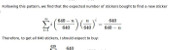
Therefore, to get all 682 stickers, you should expect to buy
$$\sum_{n=0}^{19}\frac{682}{20-n} = 2453 \text{ stickers}.$$
You want a specific set of 20 stickers. Imagine you have already \(n\) of these. The probability that the next sticker you buy is one that you want is
$$\frac{20-n}{682}.$$
The probability that the second sticker you buy is the next new sticker is
$$\mathbb{P}(\text{next sticker is not wanted})\times\mathbb{P}(\text{sticker after next is wanted})$$
$$=\frac{662+n}{682}\times\frac{20-n}{682}.$$
Following the same method, we can see that the probability that the \(i\)th sticker you buy is the next wanted sticker is
$$\left(\frac{662+n}{682}\right)^{i-1}\times\frac{20-n}{682}.$$
Using this, we can calculate the expected number of stickers you will need to buy until you find the next wanted one:
$$\sum_{i=1}^{\infty}i \left(\frac{20-n}{682}\right) \left(\frac{662+n}{682}\right)^{i-1} = \frac{682}{20-n}$$
Therefore, to get all 682 stickers, you should expect to buy
$$\sum_{n=0}^{19}\frac{682}{20-n} = 2453 \text{ stickers}.$$
Matthew
@Matthew: Yes, I would like to know how you work it out please. I believe I have left my email address in my comment. It seems like a lot of stickers if you are just interested in one team.
Milad
@Milad: Following a similiar method to this blog post, I reckon you'd expect to buy 2453 stickers (491 packs) to get a fixed set of 20 stickers. Drop me an email if you want me to explain how I worked this out.
Matthew
Thanks for the maths, but I have one probability question. How many packs would I have to buy, on average, to obtain a fixed set of 20 stickers?
Milad
Add a Comment
2017-11-14
A few weeks ago, I took the copy of MENACE that I built to Manchester Science Festival, where it played around 300 games against the public while learning to play Noughts and Crosses. The group of us operating MENACE for the weekend included Matt Parker, who made two videos about it. Special thanks go to Matt, plus
Katie Steckles,
Alison Clarke,
Andrew Taylor,
Ashley Frankland,
David Williams,
Paul Taylor,
Sam Headleand,
Trent Burton, and
Zoe Griffiths for helping to operate MENACE for the weekend.
As my original post about MENACE explains in more detail, MENACE is a machine built from 304 matchboxes that learns to play Noughts and Crosses. Each box displays a possible position that the machine can face and contains coloured beads that correspond to the moves it could make. At the end of each game, beads are added or removed depending on the outcome to teach MENACE to play better.
Saturday
On Saturday, MENACE was set up with 8 beads of each colour in the first move box; 3 of each colour in the second move boxes; 2 of each colour in third move boxes; and 1 of each colour in the fourth move boxes. I had only included one copy of moves that are the same due to symmetry.
The plot below shows the number of beads in MENACE's first box as the day progressed.
)
Sunday
Originally, we were planning to let MENACE learn over the course of both days, but it learned more quickly than we had expected on Saturday, so we reset is on Sunday, but set it up slightly differently. On Sunday, MENACE was set up with 4 beads of each colour in the first move box; 3 of each colour in the second move boxes; 2 of each colour in third move boxes; and 1 of each colour in the fourth move boxes. This time, we left all the beads in the boxes and didn't remove any due to symmetry.
The plot below shows the number of beads in MENACE's first box as the day progressed.
)
The data
You can download the full set of data that we collected over the weekend here. This includes the first two moves and outcomes of all the games over the two days, plus the number of beads in each box at the end of each day. If you do something interesting (or non-interesting) with the data, let me know!
(Click on one of these icons to react to this blog post)
You might also enjoy...
Comments
Comments in green were written by me. Comments in blue were not written by me.
WRT the comment 2017-11-17, and exactly one year later, I had the same thing happen whilst running MENACE in a 'Resign' loop for a few hours, unattended. When I returned, the orange overlay had appeared, making the screen quite difficult to read on an iPad.
g0mrb
On the JavaScript version, MENACE2 (a second version of MENACE which learns in the same way, to play against the original) keeps setting the 6th move as NaN, meaning it cannot function. Is there a fix for this?
Lambert
what would happen if you loaded the boxes slightly differently. if you started with one bead corresponding to each move in each box. if the bead caused the machine to lose you remove only that bead. if the game draws you leave the bead in play if the bead causes a win you put an extra bead in each of the boxes that led to the win. if the box becomes empty you remove the bead that lead to that result from the box before
Ian
Hi, I was playing with MENACE, and after a while the page redrew with a Dragon Curves design over the top. MENACE was still working alright but it was difficult to see what I was doing due to the overlay. I did a screen capture of it if you want to see it.
Russ
Add a Comment
I am the author of the OEIS sequence. It's a pity that the sequence was not mentioned in Matt Parker's video.
Earlier this year I've made some analysis of the solutions: https://habr.com/ru/articles/889958/
In particular, there are solutions where all squares from 1 to 9 stack in one row or column (1+2+...+9 = 45).
As for the symmetry, the proof is the following: The symmetry could be horizontal (which is nearly the same as vertical) or diagonal.
In case of horizontal, the square of size 1 must be located on the center line. It will be either near the wall, or between 2 larger squares, that are centered on the center line. In both cases a lane of width 1 arises, that cannot be filled with any other square.
In case of diagonal, the square of size 1 must be on the diagonal and at first sight there is no lane of width 1. But, as long as you put all diagonal squares and then any square adjacent to the square of size 1, such a lane arises.
Your heatmap for size 1 is great!