mscroggs.co.uk
mscroggs.co.uk

subscribe

Blog

Tube map kaleidocycles

 2016-09-06 
This is the fifth post in a series of posts about tube map folding.
After my talk at Electromagnetic Field 2014, I was sent a copy of MC Escher Kaleidocycles by Doris Schattschneider and Wallace Walker (thanks Bob!). A kaleidocycle is a bit like a 3D flexagon: it can be flexed to reveal different parts of itself.
In this blog post, I will tell you how to make a kaleidocycle from tube maps.

You will need

Making the modules

First, fold the cover of a tube map over. This will allow you to have the tube map (and not just its cover) on the faces of your shape.
With the side you want to see facing down, fold the map so that two opposite corners touch.
For this step, there is a choice of which two corners to connect: leading to a right-handed and a left-handed piece. You should make 6 of each type for your kaleidocycle.
Finally, fold the overhanding bits over to complete your module.
The folds you made when connecting opposite corners will need to fold both ways when you flex your shape, so it is worth folding them both ways a few times now before continuing.

Putting it together

Once you have made 12 modules (with 6 of each handedness), you are ready to put the kaleidocycle together.
Take two tube maps of each handedness and tuck them together in a line. Each map is tucked into one of the opposite handedness.
The four triangles across the middle form a net of a tetrahedron. Complete the tetrahedron by putting the last tab into the first triangle. Glue these together.
Take two more tube maps of the opposite handedness to those at the top of the tetrahedron. Fit them into the two triangles poking out of the top of the tetrahedron to make a second tetrahedron.
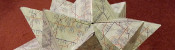
Repeat this until you have five connected tetrahedra. Finally, connect the triangles poking out of the top and the bottom to make your kaleidocycle.
This is the fifth post in a series of posts about tube map folding.

                        
(Click on one of these icons to react to this blog post)

You might also enjoy...
Comments

Comments in green were written by me. Comments in blue were not written by me.
 Add a Comment 


I will only use your email address to reply to your comment (if a reply is needed).

Allowed HTML tags: <br> <a> <small> <b> <i> <s> <sup> <sub> <u> <spoiler> <ul> <ol> <li> <logo>
To prove you are not a spam bot, please type "y-axis" in the box below (case sensitive):

Archive

Show me a random blog post
 2026 

May 2026

World Cup stickers 2026

Apr 2026

A new puzzle every day
Mixing Wordle with other games

Feb 2026

Christmas (2025) is over
 2025 

Dec 2025

Christmas card 2025

Nov 2025

Christmas (2025) is coming!

Sep 2025

The partridge puzzle

Aug 2025

TMiP 2025 puzzle hunt

Jun 2025

A nonogram alphabet

Mar 2025

How to write a crossnumber

Jan 2025

Christmas (2024) is over
Friendly squares
 2024 

Dec 2024

A regular expression Christmas puzzle
Christmas card 2024

Nov 2024

Christmas (2024) is coming!

Feb 2024

Zines, pt. 2

Jan 2024

Christmas (2023) is over
 2023 
▼ show ▼
 2022 
▼ show ▼
 2021 
▼ show ▼
 2020 
▼ show ▼
 2019 
▼ show ▼
 2018 
▼ show ▼
 2017 
▼ show ▼
 2016 
▼ show ▼
 2015 
▼ show ▼
 2014 
▼ show ▼
 2013 
▼ show ▼
 2012 
▼ show ▼

Tags

numbers sound dinosaurs wordle sobolev spaces raspberry pi errors wave scattering realhats coventry pizza cutting signorini conditions datasaurus dozen oeis triangles turtles zines live stream fence posts interpolation mathsjam go gerry anderson binary talking maths in public folding tube maps runge's phenomenon hats captain scarlet tennis game of life exponential growth crossnumbers ternary plastic ratio books pi bluesky squares graphs reddit 24 hour maths sorting pi approximation day martin gardner gather town computational complexity graph theory crochet rugby logs national lottery light propositional calculus harriss spiral bempp kenilworth geometry royal baby pythagoras logic simultaneous equations folding paper alphabets standard deviation thirteen people maths error bars trigonometry matrix of minors dates mathslogicbot preconditioning craft cambridge youtube map projections javascript pascal's triangle draughts bubble bobble matrix of cofactors boundary element methods game show probability accuracy sport latex dragon curves tetris final fantasy chalkdust magazine bots london recursion matt parker polynomials golden spiral edinburgh royal institution misleading statistics puzzles pokémon hexapawn friendly squares python weather station bodmas matrices platonic solids flexagons programming php crossnumber frobel noughts and crosses braiding christmas determinants anscombe's quartet electromagnetic field quadrilaterals advent calendar stickers approximation mean coins chess regular expressions a gamut of games geogebra finite element method world cup christmas card london underground machine learning asteroids finite group cross stitch video games games warwick european cup hannah fry pokémon wordle partridge puzzle manchester science festival pac-man data visualisation reuleaux polygons phd speed rhombicuboctahedron gaussian elimination data nine men's morris curvature wool manchester inline code arrangement puzzles ucl radio 4 stirling numbers fractals countdown correlation probability fonts golden ratio tmip hyperbolic surfaces the aperiodical football chebyshev matrix multiplication menace rust inverse matrices newcastle weak imposition news logo palindromes estimation dataset kings arithmetic big internet math-off crosswords guest posts nonograms databet mathsteroids statistics convergence numerical analysis

Archive

Show me a random blog post
▼ show ▼
© Matthew Scroggs 2012–2026