mscroggs.co.uk
mscroggs.co.uk
Click here to win prizes by solving the mscroggs.co.uk puzzle Advent calendar.

subscribe

Blog

Tube map Platonic solids

 2012-10-06 
This is the first post in a series of posts about tube map folding.
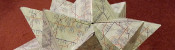
This week, after re-reading chapter two of Alex's Adventures in Numberland (where Alex learns to fold business cards into tetrahedrons, cubes and octahedrons) on the tube, I folded two tube maps into a tetrahedron:
Following this, I folded a cube, an octahedron and an icosahedron:
The tetrahedron, icosahedron and octahedron were all made in the same way, as seen in Numberland: folding the map in two, so that a pair of opposite corners meet, then folding the sides over to make a triangle:
In order to get an equilateral triangle at this point, paper with sides in a ratio of 1:√3 is required. Although it is not exact, the proportions of a tube map are close enough to this to get an almost equilateral triangle. Putting one of these pieces together with a mirror image piece (one where the other two corners were folded together at the start) gives a tetrahedron. The larger solids are obtained by using a larger number of maps.
The cube—also found in Numberland—can me made by placing two tube maps on each other at right angles and folding over the extra length:
Six of these pieces combine to give a cube.
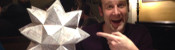
Finally this morning, with a little help from the internet, I folded a dodecahedron, thus completing all the Platonic solids:
To spread the joy of folding tube maps, each time I take the tube, I am going to fold a tetrahedron from two maps and leave it on the maps when I leave the tube. I started this yesterday, leaving a tetrahedron on the maps at South Harrow. In the evening, it was still there:
Do you think it will still be there on Monday morning? How often do you think I will return to find a tetrahedron still there? I will be keeping a tetrahedron diary so we can find out the answers to these most important questions...
This is the first post in a series of posts about tube map folding.
      ×5      ×5      ×3      ×3
(Click on one of these icons to react to this blog post)

You might also enjoy...
Comments

Comments in green were written by me. Comments in blue were not written by me.
New test comment please ignore
Matthew
×5   ×4   ×6   ×5   ×5     Reply
Test comment please ignore
Matthew
×4   ×7   ×8   ×5   ×5     Reply
 Add a Comment 


I will only use your email address to reply to your comment (if a reply is needed).

Allowed HTML tags: <br> <a> <small> <b> <i> <s> <sup> <sub> <u> <spoiler> <ul> <ol> <li> <logo>
To prove you are not a spam bot, please type "regetni" backwards in the box below (case sensitive):

Archive

Show me a random blog post
 2026 

Nov 2026

Christmas (2026) is coming!

May 2026

World Cup stickers 2026

Apr 2026

A new puzzle every day
Mixing Wordle with other games

Feb 2026

Christmas (2025) is over
 2025 

Dec 2025

Christmas card 2025

Nov 2025

Christmas (2025) is coming!

Sep 2025

The partridge puzzle

Aug 2025

TMiP 2025 puzzle hunt

Jun 2025

A nonogram alphabet

Mar 2025

How to write a crossnumber

Jan 2025

Christmas (2024) is over
Friendly squares
 2024 

Dec 2024

A regular expression Christmas puzzle
Christmas card 2024

Nov 2024

Christmas (2024) is coming!

Feb 2024

Zines, pt. 2

Jan 2024

Christmas (2023) is over
 2023 
▼ show ▼
 2022 
▼ show ▼
 2021 
▼ show ▼
 2020 
▼ show ▼
 2019 
▼ show ▼
 2018 
▼ show ▼
 2017 
▼ show ▼
 2016 
▼ show ▼
 2015 
▼ show ▼
 2014 
▼ show ▼
 2013 
▼ show ▼
 2012 
▼ show ▼

Tags

craft books fence posts databet sport matrix multiplication countdown weak imposition people maths games ucl simultaneous equations phd coventry speed pokémon wordle crossnumber logo game show probability christmas wool sound data visualisation gather town friendly squares stickers javascript stirling numbers crosswords bots royal institution london underground hexapawn braiding the aperiodical golden ratio electromagnetic field statistics correlation football arrangement puzzles nonograms matrix of cofactors ternary exponential growth raspberry pi golden spiral royal baby boundary element methods triangles european cup draughts weather station tennis oeis radio 4 thirteen rust platonic solids mean asteroids edinburgh bubble bobble mathsteroids chalkdust magazine game of life mathslogicbot dataset big internet math-off fonts realhats bodmas bempp national lottery flexagons kenilworth data standard deviation php trigonometry final fantasy guest posts convergence inline code rugby logs determinants warwick sobolev spaces pi approximation day turtles palindromes binary arithmetic geogebra reuleaux polygons misleading statistics interpolation folding tube maps manchester science festival programming pokémon kings world cup partridge puzzle runge's phenomenon nine men's morris errors pythagoras harriss spiral video games numerical analysis alphabets logic chess geometry talking maths in public matt parker squares matrix of minors preconditioning finite group gerry anderson chebyshev pac-man news regular expressions christmas card recursion graph theory pizza cutting sorting probability tmip captain scarlet crossnumbers 24 hour maths hyperbolic surfaces latex matrices quadrilaterals tetris mathsjam map projections approximation frobel error bars computational complexity anscombe's quartet fractals folding paper datasaurus dozen numbers zines light noughts and crosses accuracy hats youtube pascal's triangle graphs cambridge newcastle reddit dates bluesky live stream dinosaurs pi wave scattering go hannah fry machine learning london crochet menace puzzles estimation cross stitch advent calendar plastic ratio propositional calculus curvature signorini conditions polynomials python coins finite element method rhombicuboctahedron wordle dragon curves a gamut of games martin gardner gaussian elimination manchester inverse matrices

Archive

Show me a random blog post
▼ show ▼
© Matthew Scroggs 2012–2026