
Blog
2021-12-04
In November, I spent some time designing this year's Chalkdust puzzle Christmas card.
)
The card looks boring at first glance, but contains 14 puzzles. By writing the answers to the puzzles in the triangles on the front of the card, then colouring triangles containing 1s, 2s, 5s or 6s in the right colour, you will reveal a Christmas themed picture.
If you want to try the card yourself, you can download this printable A4 pdf. Alternatively, you can find the puzzles below and type the answers in the boxes. The answers will automatically be written in the triangles, and the triangles will be coloured...
The puzzles | ||
| 1. | What is the sum of all the odd integers between 0 and 30? | Answer |
| 2. | What is the sum of all the odd integers between 0 and 5668? | Answer |
| 3. | What is the smallest integer with a digital sum of 28 and a digital product of 10000? | Answer |
| 4. | What is the smallest integer with a digital sum of 41 and a digital product of 432000? | Answer |
| 5. | What is the area of the largest area dodecagon that will fit inside a circle with area \(111185\pi\)? | Answer |
| 6. | What is the area of the largest area heptagon that will fit inside a semicircle with area \(115185\pi\)? | Answer |
| 7. | How many terms are there in the (simplified) expansion of \((x+y+z)^{2}\)? | Answer |
| 8. | How many terms are there in the (simplified) expansion of \((x+y+z)^{41172}\)? | Answer |
| 9. | What is the largest integer that cannot be written as \(4a+5b\) for non-negative integers \(a\) and \(b\)? | Answer |
| 10. | What is the largest integer that cannot be written as \(83409a+66608b\) for non-negative integers \(a\) and \(b\)? | Answer |
| 11. | How many positive integers are there below 100 whose digits are all non-zero and different? | Answer |
| 12. | How many positive integers are there whose digits are all non-zero and different? | Answer |
| 13. | What is the only integer for which taking the geometric mean of all its factors (including 1 and the number itself) gives 2? | Answer |
| 14. | What is the only integer for which taking the geometric mean of all its factors (including 1 and the number itself) gives 25? | Answer |
 ×1 ×1 ×1 ×1 ×1
(Click on one of these icons to react to this blog post)
You might also enjoy...
Comments
Comments in green were written by me. Comments in blue were not written by me.
⭐ top comment (2021-12-13) ⭐
@HJ: the smallest one does have 6, and Q4 is correct too. I bought the cards and had good fun solving it myself. I’m glad to find this here though to check my answers as when I did the shading it looked like the picture wasn’t quite right. Thanks for the cards Matthew, I look forward to next year’s - no pressure!Alec
×2 ×3 The only one I'm stuck on is #6. I thought I was doing it right but I'm getting a non-integer answer. I'm assuming the heptagon in question is aligned so one of its sides sits on the diameter of the semicircle, and the opposite vertex sits on the curved edge of the semicircle. Is this wrong?
Seth C
The version of the card on this page doesn't check if your answers are correct, so it will colour in any number you enter as long as it has the right number of digits. ×1
Matthew
×1 Wonky solution for #9? On a blank start page, answering "16" gives you red and white puzzle completions, yet we _know_ that 16 is an incorrect answer. Strange?
Attika
Add a Comment
2021-09-25
A few weeks ago, I (virtually) went to Talking Maths in Public (TMiP). TMiP is a conference for anyone involved
in—or interested in getting involved in—any sort of maths outreach, enrichment, or public engagement activity. It was really good, and I highly recommend coming to TMiP 2023.
The Saturday morning at TMiP was filled with a choice of activities, including a puzzle hunt written by me. Each puzzle required the solver to first find a clue hidden in
the conference's Gather-Town-powered virtual Edinburgh (built by the always excellent Katie Steckles), then solve the puzzle to reveal a clue to the final code. Once the final code was found, the solvers could enter
a secret area in the Gather Town space.
The puzzles for the puzzle hunt can be found at mscroggs.co.uk/tmip. For anyone who doesn't have access to the Gather Town space, the numbers that are hidden in the space are:
- Puzzle 1: The mathematician (Thomas Bayes) died in 1761.
- Puzzle 2: The sign claims that Arthur's seat is 1288 links tall.
- Puzzle 3: The sign claims that the maximum capicity of the museum is 2449 people.
- Puzzle 4: Dynamic Earth became a charitable trust in 94.
- Puzzle 5: The 102 bus goes to Dumfries.
The solutions to the five puzzles, and the final puzzle are below. If you want to try the puzzles for yourself, do that now before reading on.
Puzzle 1: The strange shop
A shop has a very strange pricing model. If you buy \(k\) items, then the price (in pence) is decided as follows:
- If \(k\) is prime, then the price is \(k\) pence.
- If \(k\) is not prime, then double \(k\) and add one:
- If the result is prime, that is the price.
- If the result is not prime, keep doubling and adding one until a prime is reached.
You enter the shop with 1761 pence and buy 28 items.
How many pence do you leave the shop with?
Fun fact: If you try to buy 509202 items from the shop, then the shopkeeper cannot work out a price,
as a prime is never reached. It is currently unknown if this is the smallest number of items that
this is true for.
Puzzle 2: The homemade notebook
You make a homemade notebook with 1288 pages:
You take a stack of 1288/4 pieces of paper and fold the entire stack in half so that
each piece of paper makes four pages in the notebook. You number the pages:
you write the number 1 on the front cover, 2 on the inside front cover, and so on
until you write 1288 on the back cover.
While you are looking for your stapler, a strong wind blows the pieces of paper all
over the floor. You pick up one of the pieces of paper and add up the two numbers
you wrote on one side of it.
What is the largest total you could have obtained?
Puzzle 3: The overlapping triangles
You draw three circles that all meet at a point:
You then draw two triangles. The smaller red triangle's vertices are the centres of the circles. The larger blue triangle's vertices are at the points on each circle diametrically opposite the point where all three circles meet:
The area of the smaller red triangle is 2449.
What is the area of the larger blue triangle?
The odd factors
You write down the integers from 94+1 to 2×94 (including 94+1 and 2×94). Under each number, you write down its largest odd factor*.
What is the sum of all the odd factors you have written?
* In this puzzle, factors include 1 and the number itself.
Hint: Doing what the puzzle says may take a long time. Try doing this will some smaller values than 94 first and see if you can spot a shortcut.
The sandwiched quadratic
You know that \(f\) is a quadratic, and so can be written as \(f(x)=ax^2+bx+c\) for some real numbers \(a\), \(b\), and \(c\);
but you've forgetten exactly which quadratic it is. You remember that for all real values of \(x\), \(f\) satisfies
$$\tfrac{1}{4}x^2+2x-8\leqslant f(x)\leqslant(x-2)^2.$$
You also remember that the minimum value of \(f\) is at \(x=0\).
What is f(102)?
The final puzzle
The final puzzle involves using the answers to the five puzzles to find a secret four digit passcode is made up of four non-zero digits. To turn them into clues,
the answers to each puzzle were scored as follows:
Each digit in an answer that is also in the passcode and in the same position in both scores two points; every digit in the answer that is also in the passcode but in a different position scores 1 point. For example, if the passcode was 3317, then:
- 4686 would score 0 points (no digits correct);
- 4676 would score 1 point (7 is a correct digit but in the wrong position);
- 4616 would score 2 points (1 is a correct digit in the correct position);
- 4343 would score 3 points (one of the 3s is a correct digit in the correct position, the other 3 is a correct digit in the wrong position);
- 7333 would score 4 points (one of the 3s is a correct digit in the correct position, the 7 and one of the other 3s are correct digits in wrong positions. Note that the third three scores nothing);
- and 1733 would score 4 points (all four digits are correct digits in wrong positions).
The five clues to the final code are:
- Puzzle 1: 1298 scores 3 points.
- Puzzle 2: 1289 scores 3 points.
- Puzzle 3: 9697 scores 3 points.
- Puzzle 4: 8836 scores 1 point.
- Puzzle 5: 5198 scores 4 points.
×3 ×3 ×3 ×3 ×3(Click on one of these icons to react to this blog post)
You might also enjoy...

Comments
Comments in green were written by me. Comments in blue were not written by me.
Small nitpick on problem 1 fun fact. I think you meant 509202. 509203 is already prime so the price would be 509203. The way you set up the problem (2a_n+1) only gets to (k*2^n-1) if you start with k-1, so your k needs to be one smaller than the Wikipedia's k.×3 ×3 ×3 ×2 ×2
Dan
×3 ×3 ×3 ×2 ×2 Add a Comment
2020-12-03
In November, I spent some time designing this year's Chalkdust puzzle Christmas card.
)
The card looks boring at first glance, but contains 9 puzzles. By splitting the answers into two digit numbers, then colouring the regions labelled with each number (eg if an answer to a question in the red section is 201304, colour the regions labelled 20, 13 and 4 red), you will reveal a Christmas themed picture.
If you want to try the card yourself, you can download this pdf. Alternatively, you can find the puzzles below and type the answers in the boxes. The answers will be automatically be split into two digit numbers, and the regions will be coloured...
Grey/black | ||
| 1. | How many odd numbers can you make (by writing digits next to each other, so 13, 1253, and 457 all count) using the digits 1, 2, 3, 4, 5, and 7 each at most once (and no other digits)? | Answer |
| 2. | Carol made a book by stacking 40300 pieces of paper, folding the stack in half, then writing the numbers 1 to 161200 on the pages. She then pulled out one piece of paper and added up the four numbers written on it. What is the largest number she could have reached? | Answer |
| 3. | What is the sum of all the odd numbers between 0 and 130376? | Answer |
White/yellow | ||
| 4. | There are three cards with integers written on them. The pairs of cards add to 31, 35 and 36. What is the sum of all three cards? | Answer |
| 5. | What is the volume of the smallest cuboid that a square-based pyramid with volume 1337 can fit inside?? | Answer |
| 6. | What is the lowest common multiple of 305 and 671? | Answer |
Red | ||
| 7. | Holly rolled a huge pile of dice and added up all the top faces to get 6136. She realised that the probability of getting 6136 was the same as getting 9999. How many dice did she roll? | Answer |
| 8. | How many squares (of any size) are there in a 14×16 grid of squares? | Answer |
| 9. | Ivy picked a number, removed a digit, then added her two numbers to get 155667. What was her original number? | Answer |
×2 ×2 ×2 ×2 ×1(Click on one of these icons to react to this blog post)
You might also enjoy...
Comments
Comments in green were written by me. Comments in blue were not written by me.
@JDev: lots of the card will still be brown once you're done, but you should see a nice picture. Perhaps one of your answers is wrong, making a mess of the picture? ×1 ×1 ×1 ×1
Matthew
×1 ×1 ×1 ×1 I finished all of the puzzles but the picture is far from colored in. Am I missing something?
These puzzles have been a blast!×1 ×1 ×1 ×1
These puzzles have been a blast!
JDev
×1 ×1 ×1 ×1 @Tara: I initially made the same mistake. Maybe you didn't take into account that 6 is not one of the available digits in question 1?×1 ×2
Sean
×1 ×2 @Tara: Yes, looks like you may have got an incorrect answer for one of the black puzzles ×1 ×2 ×1 ×1 ×1
Matthew
×1 ×2 ×1 ×1 ×1 Add a Comment
2019-12-08
Just like last year, the year before and the year before, TD and I spent some time in November this year designing a Chalkdust puzzle Christmas card.
)
The card looks boring at first glance, but contains 9 puzzles. By splitting the answers into two digit numbers, then drawing lines labelled with each number (eg if an answer is 201304, draw the lines labelled 20, 13 and 4), you will reveal a Christmas themed picture. Colouring the regions of the card containing circles red, the regions containing squares green, and the regions containing stars white or yellow will make this picture even nicer.
If you want to try the card yourself, you can download this pdf. Alternatively, you can find the puzzles below and type the answers in the boxes. The answers will be automatically be split into two digit numbers, the lines will be drawn, and the regions will be coloured...
| 1. | If you write out the numbers from 1 to 10,000 (inclusive), how many times will you write the digit 1? | Answer |
| 2. | What is the sum of all the odd numbers between 0 and 86? | Answer |
| 3. | How many numbers between 1 and 4,008,004 (inclusive) have an odd number of factors (including 1 and the number itself)? | Answer |
| 4. | In a book with pages numbered from 1 to 130,404, what do the two page numbers on the centre spread add up to? | Answer |
| 5. | What is the area of the largest area quadrilateral that will fit inside a circle with area 60,153π? | Answer |
| 6. | There are 5 ways to write 4 as the sum of ones and twos (1+1+1+1, 1+1+2, 1+2+1, 2+1+1, and 2+2). How many ways can you write 28 as the sum of ones and twos? | Answer |
| 7. | What is the lowest common multiple of 1025 and 835? | Answer |
| 8. | How many zeros does 245! (245!=245×244×243×...×1) end in? | Answer |
| 9. | Carol picked a 6-digit number then removed one of its digits to make a 5-digit number. The sum of her 6-digit and 5-digit numbers is 334877. Which 6-digit number did she pick? | Answer |
×3 ×3 ×3 ×3 ×3(Click on one of these icons to react to this blog post)
You might also enjoy...
Comments
Comments in green were written by me. Comments in blue were not written by me.
Thanks for the feedback. (I now understand the need for redaction). My son sent me your link as a Xmas present. I must think of an appropriate retaliation. (What is a PDF?)Think I've fixed 1,6 and 9....8 eludes me, for the moment.×3 ×3 ×3 ×3 ×3
Rob
×3 ×3 ×3 ×3 ×3 @Rob: It looks to me like you've made mistakes in questions 1, 6, 8, and 9. The hints from the back of the pdf might help:
1. How many numbers between 1 and 10,000 have 1 as their final digit? How many have 1 as their penultimate digit?
6. How many ways can you write 1? 2? 3? 4? 5? What's the pattern?
8. How many zeros does 10! end in? How many zeros does 20! end in? How many zeros does 30! end in?
9. Carol’s sum is odd. What does this tell you about the 5- and 6-digit numbers?×4 ×3 ×4 ×3 ×4
1. How many numbers between 1 and 10,000 have 1 as their final digit? How many have 1 as their penultimate digit?
6. How many ways can you write 1? 2? 3? 4? 5? What's the pattern?
8. How many zeros does 10! end in? How many zeros does 20! end in? How many zeros does 30! end in?
9. Carol’s sum is odd. What does this tell you about the 5- and 6-digit numbers?
Matthew
×4 ×3 ×4 ×3 ×4 I'm 71, with one good eye left. What am I missing?
1. 400001
2. 1849
3. 2002
4. 130405
5. 120306
6. 53?
7. 171175
8. 59?
9. 313525×2 ×2 ×2 ×2 ×1
1. 400001
2. 1849
3. 2002
4. 130405
5. 120306
6. 53?
7. 171175
8. 59?
9. 313525
Rob
×2 ×2 ×2 ×2 ×1 Add a Comment
2019-09-01
This week, I've been in Cambridge for Talking Maths in Public (TMiP). TMiP is a conference for anyone involved in—or interested in getting involved
in—any sort of maths outreach, enrichment, or public engagement activity. It was really good, and I highly recommend coming to TMiP 2021.
The Saturday morning at TMiP was filled with a choice of activities, including a treasure punt (a treasure hunt on a punt) written by me. This post contains the puzzle from the treasure punt for
anyone who was there and would like to revisit it, or anyone who wasn't there and would like to give it a try. In case you're not current in Cambridge on a punt, the clues that you were meant to
spot during the punt are given behing spoiler tags (hover/click to reveal).
Instructions
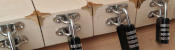
Each boat was given a copy of the instructions, and a box that was locked using a combination lock.
)
)
)
Locked boxes.
If you want to make your own treasure punt or similar activity, you can find the LaTeX code used to create the instructions and the Python code I used to check that the puzzle
has a unique solution on GitHub. It's licensed with a CC BY 4.0
licence, so you can resuse an edit it in any way you like, as long as you attribute the bits I made that you keep.
The puzzle
Four mathematicians—Ben, Katie,
Kevin, and Sam—each have one of the four clues needed to unlock a great treasure.
On a sunny/cloudy/rainy/snowy (delete as appropriate) day, they meet up in Cambridge to go punting, share their clues, work out the code for the lock,
and share out the treasure. One or more of the mathematicians, however, has decided to lie about their clue so they can steal all the treasure for themselves.
At least one mathematician is telling the truth.
(If the mathematicians say multiple sentences about their clue, then they are either all true or all false.)
They meet at Cambridge Chauffeur Punts, and head North under Silver Street Bridge.
Ben points out a plaque on the bridge with two years written on it:
"My clue," he says, "tells me that the sum of the digits of the code is equal to the sum of the digits of the earlier year on that plaque (the year is 1702). My clue also tells me that at least one of the digits of the code is 7."
The mathematicians next punt under the Mathematical Bridge, gasping in awe at its tangential trusses, then punt along the river under King's College Bridge and past King's College.
Katie points to a sign on the King's College lawn near the river:
"See that sign whose initials are PNM?" says Katie. "My clue states that first digit of the code is equal to the number of vowels on that sign (The sign says "Private: No Mooring").
My clue also tells me that at least one of the digits of the code is 1."
They then reach Clare Bridge. Kevin points out the spheres on Clare Bridge:
"My clue," he says, "states that the total number of spheres on both sides of this bridge is a factor of the code (there are 14 spheres). My clue also tells me that at least one of the digits of the code is 2."
(Kevin has not noticed that one of the spheres had a wedge missing, so counts that as a whole sphere.)
They continue past Clare College. Just before they reach Garret Hostel Bridge, Sam points out the Jerwood Library and a sign showing the year it was built (it was built in 1998):
"My clue," she says, "says that the largest prime factor of that year appears in the code (in the same way that you might say the number 18 appears in 1018 or 2189).
My clue also says that the smallest prime factor of that year appears in the code. My clue also told me that at least one of the digits of the code is 0."
They then punt under Garret Hostel Bridge, turn around between it and Trinity College Bridge, and head back towards Cambridge Chauffeur Punts.
Zut alors, the lies confuse them and they can't unlock the treasure. Can you work out who is lying and claim the treasure for yourself?
The solution
The solution to the treasure punt is given below. Once you're ready to see it, click "Show solution".
(Click on one of these icons to react to this blog post)
You might also enjoy...
Comments
Comments in green were written by me. Comments in blue were not written by me.
Add a Comment