Puzzles
Exact change
In the UK, the coins less than £1 are 1p, 2p, 5p, 10p, 20p and 50p. How many coins would I need to carry in my pocket so that I could make any value from 1p to 99p?
In the US, the coins less than $1 are 1¢, 5¢, 10¢, 25¢. How many coins would I need to carry in my pocket so that I could make any value from 1¢ to 99¢?
Show answer & extension
Hide answer & extension
In the UK, eight coins are needed: 1p, 1p, 2p, 5p, 10p, 20p, 20p, 50p.
In the US, ten coins are needed: 1¢, 1¢, 1¢, 1¢, 5¢, 10¢, 10¢, 25¢, 25¢, 25¢.
Extension
In a far away country, the unit of currency is the #, which is split into 100@ (# is like £ or $; @ is like p or ¢).
Let C be the number of coins less than #1. Let P be the number of coins needed to make any value between 1@ and 99@. Which coins should be the country mint to minimise the value of P+C?
Square cross
A figure in the shape of a cross is made from five 1 x 1 squares, as shown. The cross is inscribed in a large square whose sides are parallel to the dashed square, formed by four vertices of the cross.
What is the area of the large outer square?
Show answer
Hide answer
The smaller diagonal square is made up of a 1×1 square and four 1×2 right-angled triangles. Therefore its area is 5.
The line FM, and therefore the line DN, has gradient 2. The line JM, and therefore the line ON, has gradient -½. ON passes through (1,2) and DN passes through (2,0). Therefore, DN has equation \(y=2x-4\) and ON has equation \(y=\frac{5}{2}-\frac{1}{2}x\). These lines intersect at \((\frac{13}{5},\frac{6}{5})\), these are the co-ordinates of N. By the same method, the co-ordinates of P are \((-\frac{8}{5},-\frac{1}{5})\).
By Pythagoras' Theorem, The diagonal of the larger square is \(\frac{7\sqrt{10}}{5}\) and so the area of the larger square is 9.8.
Ten digit number
Can you create a 10-digit number, where the first digit is how many zeros in the number, the second digit is how many 1s in the number etc. until the tenth digit which is how many 9s in the number?
Mrs. Coldcream objected
"I object," said Councillor Mrs. Coldcream. "I see no reason why the boys should be so favoured at the expense of the girls."
This was at a meeting of the Holmshire Education Committee. It had been proposed to award 19 scholarships totalling £1000 to boys and girls of the county. It had been proposed that each girl receive a set amount and each boy receive £30 more than each girl.
Mrs. Coldcream pressed her point with such fervour that it was decided to reallocate the money. Each girl would receive £8 more than originally proposed, with the boys' scholarships scaled down accordingly.
How much did each boy and each girl receive?
Show answer & extension
Hide answer & extension
Let \(G\) be the number of girls, and £\(x\) be the amount each girl was originally to receive. This means that there are \(19-G\) boys who were to receive £\(x+30\). The total scholarship is £1000, so:
$$xG+(x+30)(19-G)=1000$$
This simplifies to:
$$19x-30G=430$$
\(G\) is less than 19, so the only integer solution of this equation is \(x=40\) and \(G=11\).
After the funds are redistributed, each girl therefore receives £48. Let \(B\) be the amount each boy will now receive. The total is still £1000, so:
$$48\times 11+8B=1000$$
Which can be solved to find \(B=59\).
Each girl receives £48 and each boy receives £59.
Extension
Mrs. Coldcream still feels that this is unfair. How much more should be added to each girl's scholarship (resizing the boys' accordingly) so that the girls get at least as much as the boys?
Cooked turkey
An old invoice showed that seventy-two turkeys had been purchased for "—67.9—". The first and last digits were illegible.
How much did one turkey cost?
Show answer & extension
Hide answer & extension
Let the first digit be \(a\) and the final digit be \(b\). The cost of the 72 turkeys (in pence) is \(10000a+6790+b\). This must be divisible by 72.
$$10000a+6790+b=(138\times 72+64)a+(94\times 72+22)+b$$
$$=(138a+94)\times 72+64a+22+b$$
\(10000a+6790+b\) is divisible by 72, so \(64a+22+b\) is divisible by 72. This means that \(b\) must be even (as 64,22,72 are all even). Let \(b=2c\).
Dividing by two, we find that \(32a+11+c\) is divisible by 36. \(c\) must be odd, so that \(32a+11+c\) is even. Let \(c=2d+1\) and so \(b=4d+2\).
Dividing by two again, we find that \(16a+6+d\) is divisible by 18. \(d\) must be even, so that \(16a+6+d\) is even. Let \(d=2e\) and so \(b=8e+2\). But \(b\) is a single digit number, so \(e=0\), \(b=2\) and \(16a+6\) is divisible by 18.
Dividing by two yet again, we find that \(8a+3\) is divisible by 9. \(a\) must be divisible by 3. Let \(a=3f\).
Dividing by three, we find that \(8f+1\) is divisible by 3. \(8f+1=6f+2f+1\) so \(2f+1\) is divisible by 3. This will be true when \(f=1,4,7,10,...\). \(a\) must be a single digit, so \(f=1\) and \(a=3\). And so the price of the 72 turkeys is £367.92, and one turkey will cost £5.11.
Extension
Which numbers could 72 be replaced with in the original problem so that the problem still has a unique solution?
Let the passenger train through!
A goods train, made up of a locomotive and 5 trucks, stops at a small station. The small station has a siding which the goods train can reverse into. The siding can hold an engine and two trucks or three trucks.
A passenger train arrives travelling in the opposite direction. How can they let it through? (The passenger train is too long to fit in the siding.)
Show answer & extension
Hide answer & extension
The goods train reverses into the siding, leaving three trucks, then reverses out of the way.
The passenger train attaches the three trucks to its front then reverses out of the way.
The goods train backs into the siding.
The passenger train drives past the siding.
The goods train drives forwards out of the way.
The passenger train reverses, then drives forward into the siding, leaving the three trucks. It then drives forward out of the way.
The goods train reverses into the siding, picking up the trucks. The trains have now passed each other.
Extension
1. If the goods train can drive forwards into the siding, how could it let the passenger train through?
2. If the goods train had 8 trucks, how could it let the passenger train through?
Overlapping triangles
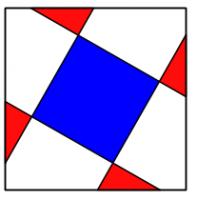
Four congruent triangles are drawn in a square.
The total area which the triangles overlap (red) is equal to the area
they don't cover (blue). What proportion of the area of the large square
does each (purple) triangle take up?
Show answer & extension
Hide answer & extension
Let \(S\) be the area of the large square, \(T\) be the area
of one of the large triangles, \(U\) be one of the red overlaps
and V be the uncovered blue square. We can write
$$S=4T-4U+V$$
as the area of the square is the total of the four triangles,
take away the overlaps as they have been double counted, add
the blue square as it has been missed.
We know that 4U=V, so
$$S=4T-V+V$$
$$S=4T.$$
Therefore one of the triangles covers one quarter of the
square.
Extension
Five congruent triangles are drawn in a regular pentagon. The
total area which the triangles overlap (red) is equal to the area they
don't cover (blue). What proportion of the area of the large pentagon
does each triangle take up?
\(n\) congruent triangles are drawn in a regular \(n\) sided polygon.
The
total
area which the triangles overlap is equal to the area they don't cover.
What proportion of the area of the large \(n\) sided polygon does each
triangle take up?
Coming and going
In my house are a number of rooms. (A hall separated from the rest of the house by one or more doors counts as a room.) Each room has an even number of doors, including doors that lead outside. Is the total number of outside doors even or odd?
Show answer & extension
Hide answer & extension
Add up the number of doors leaving each room; call the sum
\(S\).
As
the number in each room is even, \(S\) will be even. Each interior door
has
been counted twice (as they can be seen in two rooms) and each exterior
door has been counted once. Let \(I\) be the number of interior doors
and
\(E\)
be the number of exterior doors. We have:
$$S=2I+E$$
$$E=S-2I$$
\(S\) and \(2I\) are even, so \(E\) must be even.
Extension
If the number of doors in each room is odd, is the number of
exterior doors odd or even?

)
)
)
)
