Puzzles
Circles
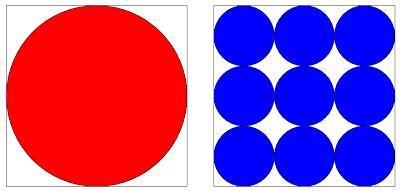
Which is largest, the red or the blue area?
Show answer & extension
Hide answer & extension
Let \(4x\) be the side length of the square. This means that the radius of the red circle is \(2x\) and the radius of a blue circle is \(x\). Therefore the area of the red circle is \(4\pi x^2\).
The area of one of the blue squares is \(\pi x^2\) so the blue area is \(4\pi x^2\). Therefore the two areas are the same.
Extension
Is the red or blue area larger?
Semi circle in a triangle
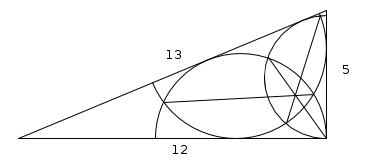
This right-angled triangle above has sides of lengths 12cm, 5cm and 13cm. The diameter of the semicircle lies on the 12cm side and the 13cm side is a tangent to the circle. What is the radius of the semi circle?
Show answer & extension
Hide answer & extension
Label the triangle as follows:
EC and BC are both tangents to the circle so FEA is a right angle and the lengths EC and BC are equal, so the length of EC is 5. Let r be the radius of the circle.
Using Pythagoras' Theorem in triangle FEA:
$$8^2+r^2=(12-r)^2$$
$$64+r^2=144-24r+r^2$$
$$24r=80$$
$$r=\frac{80}{24}=\frac{10}{3}$$
Extension
What is the radius of the circle whose diameter lies on the 5cm side and to which the 12cm and 13cm sides are tangents?
What is the radius of the circle whose diameter lies on the 13cm side and to which the 12cm and 5cm sides are tangents?
Additional observation
For each pair of semi circles, draw a straight line between the two points where the semi circles intersect. These lines all meet at a point.
Light work
"I don't know if you are fond of puzzles, or not. If you are, try this. ... A gentleman (a nobleman let us say, to make it more interesting) had a sitting-room with only one window in it—a square window, 3 feet high and 3 feet wide. Now he had weak eyes, and the window gave too much light, so (don't you like 'so' in a story?) he sent for the builder, and told him to alter it, so as only to give half the light. Only, he was to keep it square—he was to keep it 3 feet high—and he was to keep it 3 feet wide. How did he do it? Remember, he wasn't allowed to use curtains, or shutters, or coloured glass, or anything of that sort."
Lights
You have been taken captive and are blindfolded. There is a table in front of you with four lights on it. Some are on, some are off: you don't know how many and which ones. You need to get either all the lights on or all the lights off to be released. To do this, you can ask your captor to toggle the light switches of some of the lights. You captor will then rotate the table (so you don't know where the lights you toggled now are). Find a sequence of moves which will always lead to your release.
Show answer & extension
Hide answer & extension
If two lights opposite each other are on and the other two are off, then toggling two opposite lights will always lead to your release. It can be checked that the following combination will always lead to this:
- Toggle two opposite lights
- Toggle two adjacent lights
- Toggle two opposite lights
- Toggle one light
- Toggle two opposite lights
- Toggle two adjacent lights
- Toggle two opposite lights
Extension
Can the same be done with eight lights?
Princess problem
A princess lives in a row of 17 rooms. Each day she moves to a room adjacent to the one she wakes up in (eg. If she sleeps in room 5 today, then she will sleep in room 4 or 6 tomorrow). If you are able to find the princess by only opening one door each night then you will become her prince. Can you find her in a finite number of moves?
Show answer & extension
Hide answer & extension
Imagine a chessboard with 17 columns and a large number of rows. Let each column correspond to one of the rooms. In the first row, mark the room in which the princess is. Every day following, mark her location in the next row.
The princess will always move one square diagonally, so will always be on the same colour square she started on. Begin by checking the 17th room, then the 16th room, then continue down the the first room. If the princess started on a black square you will have found her, as she has no way of getting past you.
If you have not caught the princess, then she must have started on a white square. Checking rooms 17 down to one again will find her as this time it will start on a white square.
Extension
Is there a quicker way to find the princess?
Three digit numbers
Brigette wrote down a list of all 3-digit numbers. For each of the numbers on her list she found the product of the digits. She then added up all of these products. Which of the following is equal to her total?
A \(45\)
B \(45^2\)
C \(45^3\)
D \(2^{45}\)
E \(3^{45}\)
Show answer & extension
Hide answer & extension
The sum of the products is:
$$\sum_{i=1}^{9}\sum_{j=1}^{9}\sum_{k=1}^{9}ijk$$
$$=(\sum_{i=1}^{9}i)(\sum_{j=1}^{9}j)(\sum_{k=1}^{9}k)$$
$$=45\times45\times45$$
$$=45^3$$
Extension
Find the sum of the products of the digits of all n digit numbers.
Multiple sums
If we list all the natural numbers below 10 that are multiples of 3 or 5, we get 3, 5, 6 and 9. The sum of these multiples is 23.
Find the sum of all the multiples of 3 or 5 below 1000.
Show answer & extension
Hide answer & extension
The multiples of 3 less than 1000 are 3,6,9,...,999; the multiples of 5 are 5,10,15,...,995. Multiples of 15 (15,30,...,990) will appear in both lists so we are trying to find (3+6+9+...+999)+(5+10+15+...+995)-(15+30+...+990). This is:
$$\sum_{i=1}^{333}3i+\sum_{j=1}^{199}5j-\sum_{k=1}^{66}15k$$
$$=3\sum_{i=1}^{333}i+5\sum_{j=1}^{199}j-15\sum_{k=1}^{66}k$$
$$=3\times\frac{333\times334}{2}+5\times\frac{199\times200}{2}-15\times\frac{66\times67}{2}$$
$$=166833+99500-33165$$
$$=233168$$
Extension
Find the sum of all the multiples of 3 or 5 below \(n\).
Downing Street
A knot of spectators in Downing Street was watching members of the Cabinet as they arrived for a critical meeting.
"Who's that?" I asked my neighbour, as a silk-hatted figure, carrying rolled umbrella, rang the bell at No. 10. "Is it the Minister of Maths?"
"Yes," he said.
"Quite right," said a second spectator. "The Minister of Maths it is. Looks grim, doesn't he?"
The first of the speakers tells the truth three times out of four. The second tells the truth four times out of five.
What is the probability that the gentleman in question was in fact the Minister of Maths?
Show answer & extension
Hide answer & extension
The probabilities can be summarised as follows:
| First person truthful | First person lying |
| Second person truthful | \(\frac{3}{4}\times\frac{4}{5}=\frac{12}{20}\) | \(\frac{1}{4}\times\frac{4}{5}=\frac{4}{20}\) |
| Second person lying | \(\frac{3}{4}\times\frac{1}{5}=\frac{3}{20}\) | \(\frac{1}{4}\times\frac{1}{5}=\frac{1}{20}\) |
As they both agree, only both lying and both truthful are possible. Hence the chance of them lying is 1/13 and the chance of them telling the truth, and it indeed being the Minister of Maths, is 12/13
Extension
If the first person said it was the Minister of English and the second said it was the Minister of Maths, what is the probability that it was the Minister of Maths?

)
)
)
)
)
)
)
)
