mscroggs.co.uk
mscroggs.co.uk

subscribe

Blog

Logic bot, pt. 2

 2015-03-15 
A few months ago, I set @mathslogicbot (and @logicbot@mathstodon.xyz and @logicbot.bsky.social) going on the long task of tweeting all the tautologies (containing 140 characters or less) in propositional calculus with the symbols \(\neg\) (not), \(\rightarrow\) (implies), \(\leftrightarrow\) (if and only if), \(\wedge\) (and) and \(\vee\) (or). My first post on logic bot contains a full explanation of propositional calculus, formulae and tautologies.

An alternative method

Since writing the original post, I have written an alternative script to generate all the tautologies. In this new method, I run through all possible strings of length 1 made with character in the logical language, then strings of length 2, 3 and so on. The script then checks if they are valid formulae and, if so, if they are tautologies.
In the new script, only formulae where the first appearances of variables are in alphabetical order are considered. This means that duplicate tautologies are removed. For example, \((b\rightarrow(b\wedge a))\) will now be counted as it is the same as \((a\rightarrow(a\wedge b))\).
You can view or download this alternative code on github. All the terms of the sequence that I have calculated so far can be viewed here and the tautologies for these terms are here.

Sequence

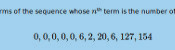
One advantage of this method is that it generates the tautologies sorted by the number of symbols they contain, meaning we can generate the sequence whose \(n\)th term is the number of tautologies of length \(n\).
The first ten terms of this sequence are
$$0, 0, 0, 0, 2, 2, 12, 6, 57, 88$$
as there are no tautologies of length less than 5; and, for example two tautologies of length 6 (\((\neg a\vee a)\) and \((a\vee \neg a)\)).
This sequence is listed as A256120 on OEIS.

Properties

There are a few properties of this sequence that can easily be shown. Throughout this section I will use \(a_n\) to represent the \(n\)th term of the sequence.
Firstly, \(a_{n+2}\geq a_n\). This can be explained as follows: let \(A\) be a tautology of length \(n\). \(\neg\neg A\) will be of length \(n+2\) and is logically equivalent to \(A\).
Another property is \(a_{n+4}\geq 2a_n\): given a tautology \(A\) of length \(n\), both \((a\vee A)\) and \((A\vee a)\) will be tautologies of length \(n+4\). Similar properties could be shown for \(\rightarrow\), \(\leftrightarrow\) and \(\wedge\).
Given properties like this, one might predict that the sequence will be increasing (\(a_{n+1}\geq a_n\)). However this is not true as \(a_7\) is 12 and \(a_8\) is only 6. It would be interesting to know at how many points in the sequence there is a term that is less than the previous one. Given the properties above it is reasonable to conjecture that this is the only one.
Edit: The sequence has been published on OEIS!
Edit: Added Mastodon and Bluesky links

×5      ×3      ×3      ×3      ×3
(Click on one of these icons to react to this blog post)

You might also enjoy...
Comments

Comments in green were written by me. Comments in blue were not written by me.
You should do a logic bot for logical graphs ...

• https://oeis.org/wiki/Logical_Graphs
• https://inquiryintoinquiry.com/2024/08...
• https://inquiryintoinquiry.com/2024/09...
• https://inquiryintoinquiry.com/2025/05...

it would be great !!!
Jon Awbrey
                 Reply
Great project! Would be interesting to have a version of this for the sheffer stroke.
om
×3   ×3   ×3   ×1   ×3     Reply
 Add a Comment 


I will only use your email address to reply to your comment (if a reply is needed).

Allowed HTML tags: <br> <a> <small> <b> <i> <s> <sup> <sub> <u> <spoiler> <ul> <ol> <li> <logo>
To prove you are not a spam bot, please type "prime" in the box below (case sensitive):

Archive

Show me a random blog post
 2026 

May 2026

World Cup stickers 2026

Apr 2026

A new puzzle every day
Mixing Wordle with other games

Feb 2026

Christmas (2025) is over
 2025 

Dec 2025

Christmas card 2025

Nov 2025

Christmas (2025) is coming!

Sep 2025

The partridge puzzle

Aug 2025

TMiP 2025 puzzle hunt

Jun 2025

A nonogram alphabet

Mar 2025

How to write a crossnumber

Jan 2025

Christmas (2024) is over
Friendly squares
 2024 

Dec 2024

A regular expression Christmas puzzle
Christmas card 2024

Nov 2024

Christmas (2024) is coming!

Feb 2024

Zines, pt. 2

Jan 2024

Christmas (2023) is over
 2023 
▼ show ▼
 2022 
▼ show ▼
 2021 
▼ show ▼
 2020 
▼ show ▼
 2019 
▼ show ▼
 2018 
▼ show ▼
 2017 
▼ show ▼
 2016 
▼ show ▼
 2015 
▼ show ▼
 2014 
▼ show ▼
 2013 
▼ show ▼
 2012 
▼ show ▼

Tags

books error bars game show probability draughts friendly squares dataset correlation pi oeis python rhombicuboctahedron video games kings youtube raspberry pi matrix of cofactors rust gerry anderson manchester the aperiodical menace datasaurus dozen captain scarlet bubble bobble mean frobel chebyshev manchester science festival runge's phenomenon weather station fractals boundary element methods accuracy approximation javascript european cup quadrilaterals machine learning pascal's triangle matrix multiplication light advent calendar nonograms cambridge wool sobolev spaces tennis games christmas card dates interpolation anscombe's quartet fonts matrix of minors dragon curves finite element method countdown sorting misleading statistics bots pac-man mathsjam warwick pythagoras craft standard deviation big internet math-off geogebra arithmetic folding paper turtles data visualisation zines hannah fry polynomials data propositional calculus gaussian elimination computational complexity world cup chalkdust magazine platonic solids convergence live stream a gamut of games finite group errors pokémon wordle harriss spiral christmas game of life databet tmip signorini conditions pokémon mathsteroids royal institution arrangement puzzles rugby realhats logo statistics talking maths in public plastic ratio folding tube maps squares coins reuleaux polygons flexagons inverse matrices determinants people maths triangles fence posts ucl stirling numbers binary simultaneous equations palindromes matrices pizza cutting graph theory stickers braiding inline code london speed programming estimation royal baby martin gardner map projections wordle pi approximation day wave scattering football 24 hour maths cross stitch partridge puzzle bempp tetris curvature ternary gather town exponential growth trigonometry reddit thirteen logic golden spiral london underground dinosaurs php guest posts go weak imposition bluesky newcastle sport golden ratio hyperbolic surfaces crochet mathslogicbot edinburgh radio 4 latex bodmas recursion sound numbers phd news regular expressions crosswords numerical analysis coventry preconditioning chess graphs hexapawn national lottery geometry logs matt parker probability hats final fantasy crossnumbers asteroids puzzles electromagnetic field alphabets noughts and crosses crossnumber nine men's morris kenilworth

Archive

Show me a random blog post
▼ show ▼
© Matthew Scroggs 2012–2026